In our increasingly screen-dominated lives, the phenomenon of digital eye strain has become a common companion for many. The discomfort of tired, dry, or strained eyes after long hours in front of computers, smartphones, or tablets is an experience shared by office workers, students, and casual users alike. While numerous strategies exist to alleviate this modern malaise, one of the most frequently recommended—and yet often misunderstood—practices is the act of looking into the distance. The simple advice to "look far away" to rest your eyes is pervasive, but the critical question remains: what should you actually be looking at? The choice of a distant object is not merely a trivial detail; it is a nuanced decision that can significantly influence the effectiveness of this visual respite.
The underlying science of why we look far begins with the very mechanics of our eyes. When focusing on nearby objects, such as a screen or a book, the ciliary muscles inside our eyes contract to adjust the shape of the lens, a process known as accommodation. This allows us to see close-up details clearly but, much like any muscle held in a sustained contraction, it leads to fatigue over time. Staring at a fixed distance for prolonged periods can cause these muscles to essentially lock up, contributing to feelings of strain, headache, and blurred vision. By shifting our gaze to something far away, we signal these muscles to relax, allowing the lens to flatten and providing much-needed relief. It is a fundamental reset for the ocular system.
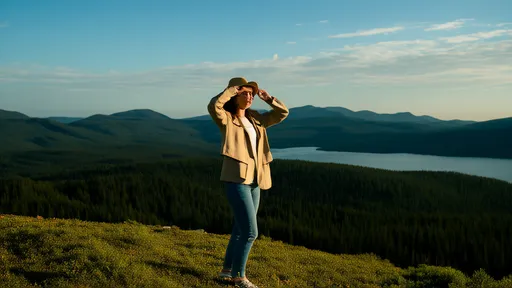
However, not all distant views are created equal. The ideal target for this purposeful gazing is something that engages the eyes in a gentle, passive manner. A natural horizon, for instance, is often cited as optimal. The reason lies in its inherent complexity and lack of demanding focal points. When you look towards a distant tree line, a mountain range, or even the sky meeting the earth, your eyes are not forced to focus sharply on any one particular element. Instead, they can roam effortlessly across a broad, soft-focus panorama. This encourages micro-movements of the eyes, preventing them from fixating statically, which is a key contributor to strain. The natural world provides a visual environment that is dynamic yet undemanding.
Conversely, choosing a poor target can negate the benefits entirely. For someone in an urban environment, the temptation might be to look at another building across the street or a detailed sign in the distance. This can be counterproductive. If the object requires significant focus to discern details—like reading text on a faraway billboard or counting the windows on a building—you are merely asking your ciliary muscles to perform a different kind of work, not allowing them to truly rest. The goal is passive observation, not active inspection. The worst thing you can do is replace one form of intense focusing with another.
Beyond the physical horizon, the sky itself presents a fascinating option. On a clear day, gazing into the vast expanse of blue sky allows the eyes to focus at optical infinity. This is the point beyond which the light rays entering the eye are essentially parallel, requiring no muscular effort to focus. It is the most relaxed state possible for the human eye. Cloud watching can be particularly beneficial, as the soft, drifting, and ever-changing shapes provide a moving target that encourages natural ocular pursuit movements without any need for concentrated focus. This combination of infinite focal distance and gentle motion makes the sky a superior choice for eye relaxation.
The element of movement cannot be overstated. A static, albeit distant, object is good, but a scene with inherent movement is superior. This is why looking out a window at leaves rustling in the wind, birds flying, or cars moving in the far distance is so effective. The human visual system is designed to track movement. This subtle tracking engages a different set of eye muscles (the extraocular muscles responsible for eye movement) in a healthy, low-stakes way, promoting blood flow and preventing stiffness. It breaks the monotony of a fixed gaze, which is the root cause of the strain in the first place. It’s the difference between holding a stretch and dynamically moving.
For those confined to interior spaces without access to a window view, all is not lost. The principle remains the same: find the farthest point in your environment and ensure it is a target that does not require active focusing. This could be the corner of the room farthest from you, a blank wall, or a piece of abstract art without fine details. The key is to defocus your eyes. Some practitioners even recommend a technique called palming after distance gazing—rubbing your hands together to generate warmth and then gently cupping them over your closed eyes—to combine muscle relaxation with soothing darkness and warmth for a deeper reset.
Ultimately, the ritual of looking far is a small but powerful act of mindfulness for your eyes. It is a deliberate pause, a conscious uncoupling from the digital world that demands our constant, close-up attention. The choice of target is what transforms this from a reflexive action into a therapeutic practice. By selecting a distant, dynamic, and non-demanding vista—preferably one infused with the softness of nature or the infinity of the sky—we grant our overworked eyes the genuine rest they deserve. It is a reminder that sometimes, the simplest solutions require a bit of thoughtful intention to be truly effective.

By /Aug 26, 2025
By /Aug 26, 2025

By /Aug 26, 2025

By /Aug 26, 2025

By /Aug 26, 2025

By /Aug 26, 2025

By /Aug 26, 2025

By /Aug 26, 2025

By /Aug 26, 2025

By /Aug 26, 2025

By /Aug 26, 2025
By /Aug 26, 2025

By /Aug 26, 2025

By /Aug 26, 2025

By /Aug 26, 2025

By /Aug 26, 2025

By /Aug 26, 2025

By /Aug 26, 2025

By /Aug 26, 2025

By /Aug 26, 2025